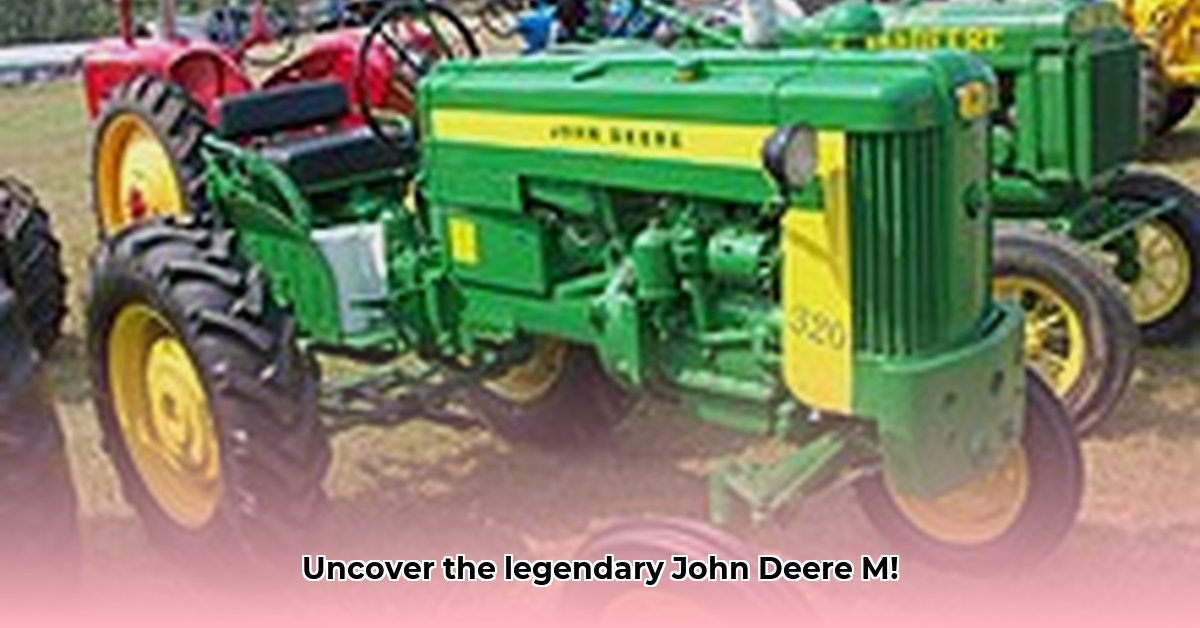
The John Deere Model M: A Legacy of Innovation
The John Deere Model Model M tractor, produced from 1947 to 1952, holds a significant place in agricultural history. Nearly 46,000 units were manufactured, a testament to its popularity and impact on farming practices. This article delves into the Model M's historical context, technical specifications, variants, and restoration, providing a comprehensive guide for enthusiasts, historians, and collectors. Did you know the innovative Touch-O-Matic hydraulic system significantly improved implement control, making a substantial difference in the efficiency and ease of farming? Learn more about tractor lifespan at tractor lifespan.
Historical Context: The Model M's Rise to Prominence
Post-World War II, the demand for efficient agricultural machinery was surging. The Model M emerged as a response to this need, bridging the gap between older, simpler tractors and the more powerful machines to come. It represented a notable advancement in farm technology, offering a balance of capability and affordability. Its design reflected advancements in engineering and manufacturing, making farming more efficient and less demanding on the operator.
Technical Specifications: Decoding the Model M's Mechanics
The heart of the Model M was a 1.6-liter, two-cylinder gasoline engine. While less powerful than modern tractors, it provided sufficient power for the tasks of the era. The unsynchronized transmission, common for tractors of that time, required skill to operate smoothly. However, the innovative Touch-O-Matic hydraulic system significantly simplified implement control, reducing operator fatigue and boosting efficiency.
| Feature | Specification | Notes |
|---|---|---|
| Engine | 1.6L, 2-cylinder gasoline | Provided adequate power for its time, although horsepower may vary compared to advertised numbers. |
| Transmission | Unsynchronized, manual | Required skill and practice for smooth shifting. |
| Hydraulic System | Touch-O-Matic (position control) | A revolutionary feature that simplified implement operation, a major advancement in tractor technology for its era. |
| Production Years | 1947-1952 | Approximately 45,799 units produced. |
Model Variations: Tailoring to Farmer Needs
Recognizing the diverse needs of farmers, John Deere produced several variations of the Model M: the standard "M," along with the "MT," "MC," and "MI." While precise differences between these models require further research into original documentation, they likely reflect variations in features and applications tailored to specific farming tasks. These variations highlight John Deere's dedication to providing farmers with the right tool for their specific needs.
The Touch-O-Matic System: A Technological Leap
The Touch-O-Matic hydraulic system deserves special attention. This innovative feature allowed for precise and effortless control of implements, significantly improving efficiency and reducing operator workload. Compared to earlier systems, Touch-O-Matic represented a giant leap forward in tractor technology, making the Model M a more desirable and user-friendly machine. While simple by today’s standards, its impact at the time was considerable. What other innovations might we see in the agricultural industry in the coming decades?
Collecting and Restoration: A Guide for Enthusiasts
For collectors and restorers, the Model M offers a rewarding, albeit challenging, project. Sourcing parts can be difficult, requiring patience and resourcefulness. Original owner's manuals and online forums dedicated to vintage tractors are invaluable resources. Common restoration challenges include sourcing rare parts, dealing with rust and corrosion, and ensuring the proper functioning of older mechanical systems. However, the reward of restoring a functional piece of history is immense.
Step-by-Step Restoration Guide:
- Assessment: Thoroughly inspect the tractor, documenting its condition.
- Parts Sourcing: Locate necessary parts through dealers, online marketplaces, and fellow enthusiasts.
- Disassembly: Carefully dismantle the tractor, noting the location of each component. Photography is crucial.
- Cleaning & Repair: Clean and repair or replace damaged parts.
- Reassembly: Reassemble the tractor meticulously, following your documentation.
- Testing: Thoroughly test all systems to ensure functionality.
The Enduring Legacy of the John Deere Model M
The John Deere Model M's impact on agriculture is undeniable. It increased productivity and efficiency, transforming farming practices for countless individuals for many decades. Beyond its practical contributions, it became a symbol of an era, representing hard work and simpler times. Its lasting appeal to collectors reflects its historical significance and enduring legacy. Its relatively simple design and ease of maintenance also contributed to its continued popularity and preservation as a cherished piece of agricultural history. What features of the Model M do you find most significant?